
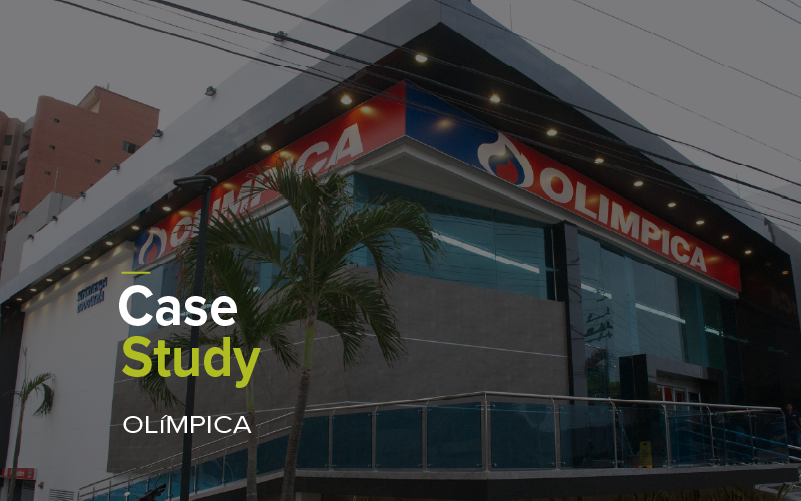
8% reduction in transportation costs. Vehicle occupancy up by 21.3%. 99% GPS fleet visibility across 128 municipalities. For one of Colombia’s largest retail chains, those results came from replacing Excel spreadsheets and institutional knowledge with algorithmic route optimization — and achieving full ROI in 12 months.
The operation: retail at national scale
Olímpica has been operating in Colombia for 71 years. Its logistics network today covers 423 points of sale across 128 municipalities, supported by five distribution centers in Barranquilla, Bogotá, Cali, Medellín, and Cartagena. The product mix runs from groceries and fresh produce to pharmaceuticals, appliances, frozen goods, and apparel — each with its own handling requirements and cost structure.
At that scale, small inefficiencies don’t stay small.
How transport planning worked before
Route planning ran on Excel. Decisions depended on the experience of platform supervisors, not on data. There was no algorithm weighing multiple variables simultaneously, no real-time fleet tracking, no digital proof of delivery.
The consequences were predictable: partially loaded trucks, no cargo consolidation across operations, reactive communication with points of sale, and no reliable KPIs to identify where money was being lost. Freight costs were accumulating without a clear picture of what was driving them.
As Danilo Velásquez, Olímpica’s Logistics Manager, noted: the phase-based implementation design was strategic from the start — ensuring controlled adoption and a stable go-live rather than a disruptive cutover.
The solution: UNIGIS TMS, implemented in phases
UNIGIS Transportation Management System is deployed in more than 50 countries across retail, consumer goods, pharma, 3PL, and e-commerce. Its core advantage over point solutions is architectural: all modules share a single database, so routing decisions incorporate real-time tracking data, and every order is traceable from planning through delivery confirmation and analysis.
The implementation followed two phases:
Phase 1 — Core operations: Optimized route planning with multi-criteria algorithms. Real-time GPS tracking with automatic alerts. Mobile confirmation of deliveries with geotagged photo POD and digital signatures.
Phase 2 — Advanced optimization and analytics: Transport tendering with rate comparison. Third-party fleet management. B2B/B2C portals for internal and external visibility. Real-time customizable KPI dashboards and automated reporting.
Results after implementation
The impact was measurable across every area the system touched.
Transportation costs dropped 8%, driven by route optimization (fewer total kilometers), cargo consolidation across operations, data-backed freight negotiations, and elimination of empty return trips and unnecessary detours. For an operation the size of Olímpica, that percentage translates to tens or hundreds of millions of Colombian pesos annually.
Vehicle occupancy improved by up to 21.3% in specific operations, with a minimum load factor of 85–90% of vehicle capacity. Fewer trucks on the road means lower fuel costs, fewer drivers, and less maintenance — across every product category.
Fleet visibility reached 99–100%, with GPS coverage across virtually the entire route network and reliable ETAs for coordination with points of sale.
Cost per kilogram transported fell across multiple categories: dry groceries, appliances, bulk goods, frozen products, and pharmaceuticals — each optimized independently within the same platform.
«By centralizing transport planning, consolidating cargo across operations, optimizing routes, and having real-time information for decision-making, we have significantly increased the efficiency of our transport process.» — Marlon Alcázar, Coastal Zone Transport Manager, Olímpica
Why an integrated suite outperforms point solutions
Many companies piece together a transport technology stack: one tool for routing, another for GPS tracking, a third for POD, a fourth for fleet management — and Excel to consolidate it all. The result is data silos, integration failures, duplicate data entry, and an inability to optimize globally because no single system has the full picture.
UNIGIS eliminates that fragmentation. One platform, one database, end-to-end visibility from planning to delivery. That’s what makes systemic optimization possible — not just improvement in one part of the operation.
«The implementation of UNIGIS allowed Olímpica to completely redesign how they plan deliveries and manage their fleet. They can now calculate the most efficient routes considering multiple variables simultaneously, assign vehicles based on real capacity, and monitor each unit’s performance in real time.» — Francisco Simbaqueva, Professional Services Manager, Cerca Technology
Cerca Technology also recognized something less visible in the numbers: «Olímpica’s commitment and willingness to absorb the full knowledge transfer were key to achieving the Bogotá and Cali rollouts autonomously.»
What this means for Colombian retail logistics
The pressure on transport efficiency in Colombia isn’t easing. Intensifying retail competition, rising fuel costs, and e-commerce-driven customer expectations for real-time visibility are all pushing logistics costs up — while margins stay flat or compress.
Olímpica’s results confirm a pattern Cerca Technology has observed across multiple TMS implementations in the sector: companies that move from manual planning to algorithmic optimization see immediate improvements in vehicle occupancy and sustained reductions in logistics costs. The combination of UNIGIS — a platform with best practices from 50+ countries — and Cerca Technology’s knowledge of Colombian regulations, geography, and operational realities produces results that neither delivers alone.
If your transport planning still runs on spreadsheets, the constraint isn’t your team’s effort — it’s the absence of a system that can optimize multiple variables at once. That gap tends to be more expensive than it looks.
Contact the Cerca Technology team to schedule a logistics diagnostic for your operation.
You may also be interested in:


